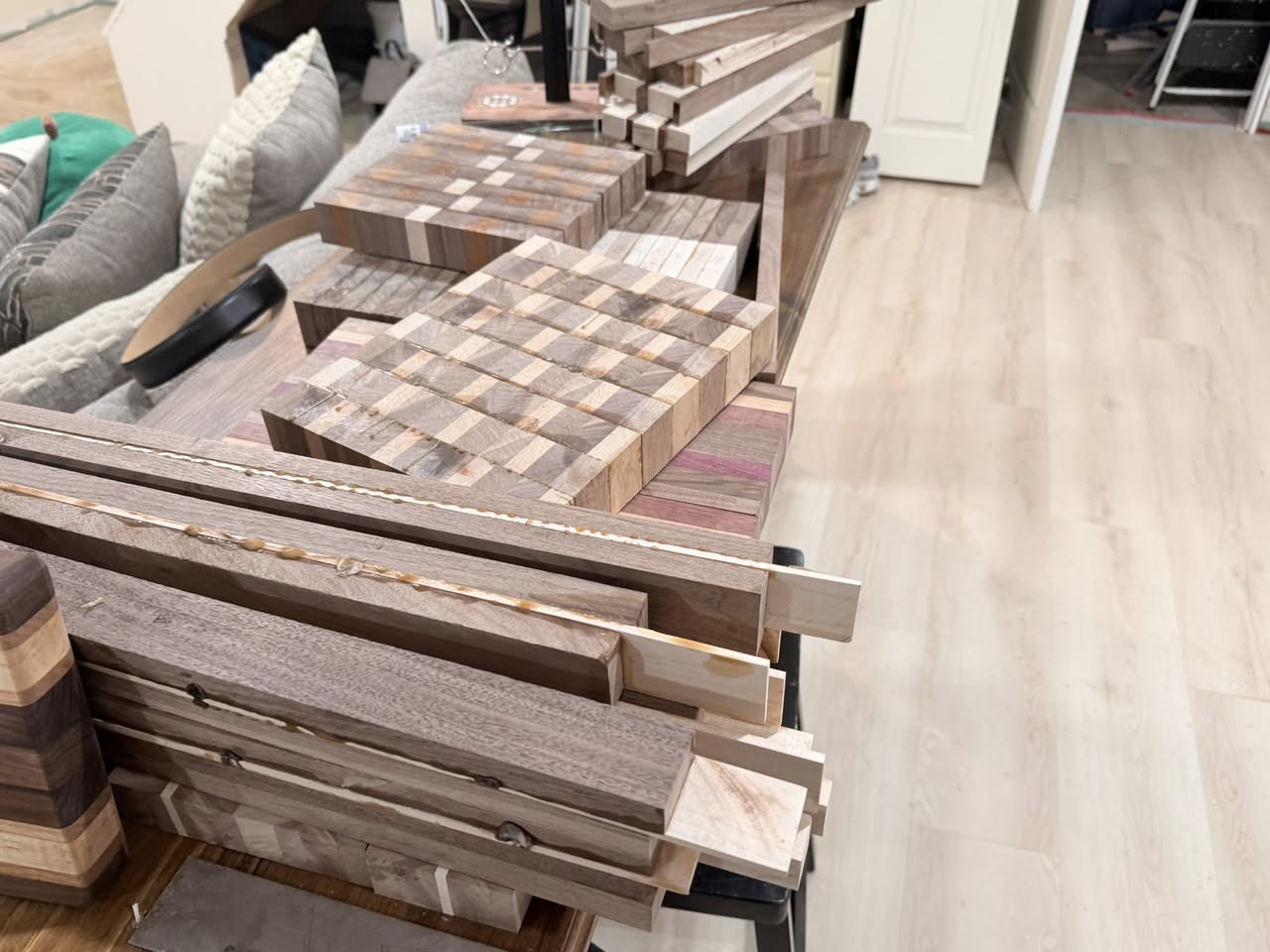
End Grain vs Edge Grain Cutting Boards
Both kinds of board start with the same hardwood — walnut, maple, cherry, or whatever species you favor. What changes is how the pieces are oriented when they're glued up, and that single choice shapes how the board feels under a knife, how it ages, and what it costs.
The fibers tell the whole story
Wood is a bundle of long vertical fibers — straws, basically — that ran up the tree from root to crown. How you cut and orient those fibers determines what your knife meets at the surface of the board.
- Edge grain boards are built from long strips laid on their side, so you're cutting across the length of the fibers — like running a knife along the side of a bundle of straws.
- End grain boards are built from short blocks stood on end, so the knife meets the open ends of the fibers — like pressing a blade down into the open tops of those same straws.
Knife wear and feel
End grain is famously "knife-friendly." When the blade comes down, it slips between vertical fibers instead of slicing through them. The fibers spring back, hiding the cut and dulling the edge less. Professional chefs and serious home cooks gravitate to end grain for exactly this reason.
Edge grain isn't harsh on knives — it's still wood, and any wood board is dramatically better than glass, marble, or ceramic. But because the blade crosses fibers instead of slipping between them, you'll feel a touch more resistance and see knife marks sooner.
Durability and looks over time
End grain boards self-heal in a small way: the standing fibers close back together after the knife lifts. Years of use leave a soft patina rather than a network of deep scars. They're also thick by necessity — usually 1.5 to 2 inches — which adds weight and stability on the counter.
Edge grain boards are dimensionally stable and forgiving. They warp less than face grain, take oil evenly, and clean up well. Expect visible knife marks as the board ages — many cooks consider that character, not damage.
Cost and craft
End grain costs more, and the reason is in the shop. A maker has to mill the boards, glue up a first panel, slice that panel into strips, rotate each strip 90 degrees, glue the strips up a second time, then flatten the whole thing. That's roughly double the lumber and double the glue-ups for the same finished footprint. Edge grain is a single glue-up and a flatten — faster, less material, lower price.
Care is the same either way
Oil with a food-safe mineral oil once a month for the first six months, then a few times a year after that. Hand-wash, don't soak, and never run a wood board through the dishwasher. Both styles will last decades if you treat them this way.
Which one is right for you?
Choose end grain if you cook daily, care about your knives, and want a board that looks new for years. Choose edge grain if you want a beautiful, durable board at a friendlier price and don't mind a little character developing as it ages.
From our workshop
Three Roots Woodworks mills hardwood lumber sized for makers building their own boards — walnut, cherry, maple, purple heart, wenge, and padauk. Browse the species and pen blanks, or get in touch about a custom run.